
From Yellow Pages to AI: How Marketing Changed in 25 Years
In 2000, a plumber in Sydney put an ad in the Yellow Pages and waited for the phone to ring. It worked. In 2010, they built a website and learned about Google. In 2020, they ran Facebook ads and posted on Instagram. In 2026, their customers are asking ChatGPT for recommendations. Every decade brings a new shift. The current one is the most significant of the lot.
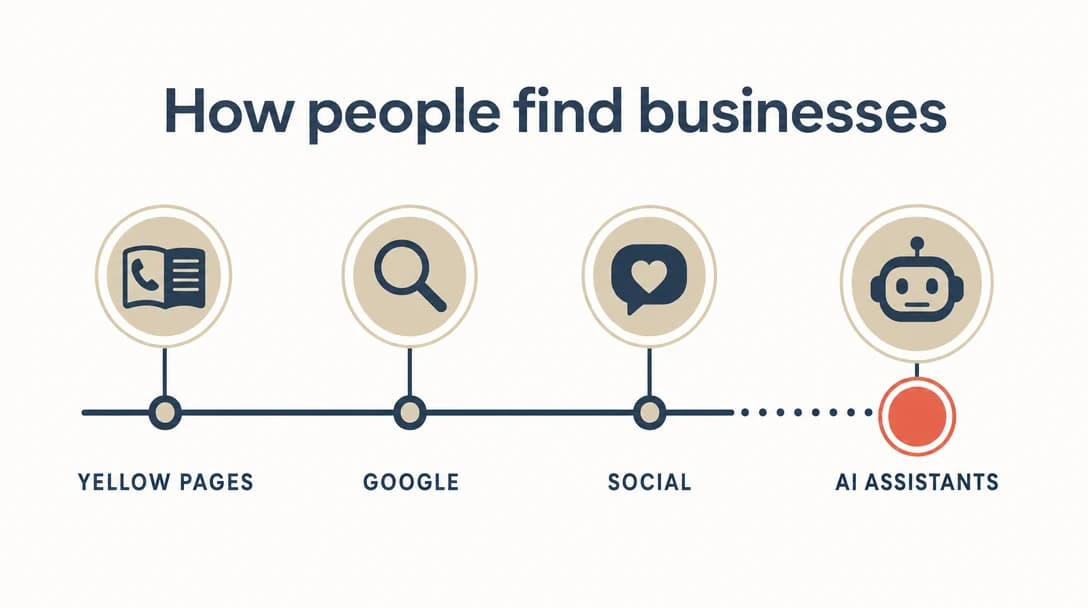
The directory era: 1990s to mid-2000s
For most of the 20th century, small business marketing was simple if not exactly cheap. Yellow Pages, local newspapers, signage, and word of mouth. You paid for a listing, you showed up in the right category, customers found you. The directory model had a clear logic: customers knew they needed a plumber, they opened the book, they called the ones with the biggest ads. The job of marketing was straightforward - be present and be visible in the places people looked.
The Google era: mid-2000s to early 2020s
Google changed everything. Suddenly, visibility wasn't about the size of your ad - it was about how well your website matched what customers were searching for. SEO became a discipline. Google Ads gave small businesses a way to buy visibility instantly. This era created an enormous opportunity for small businesses that moved early. A tradie with a decent website and basic SEO in 2008 could dominate their local area simply by showing up while competitors were still relying on directories. But as more businesses caught on, competition intensified. By the mid-2010s, the simple version of SEO - get a website, target some keywords - was no longer enough.
The social media era: 2010s
Facebook, then Instagram, then TikTok offered a new model: reach customers before they're searching. The shift from intent-based marketing (search) to interest-based marketing (social) changed how small businesses thought about customer acquisition. For some businesses, particularly retail and hospitality, social media transformed growth. For others - trades, professional services, health - social media played more of a supporting role. Brand presence mattered, but the buying decision still started with a search.
The AI era: now
The current shift is different in character from the previous ones. The earlier shifts changed the channel customers used to find businesses. The AI shift is changing the nature of the search itself. When a customer Googled 'best accountant Parramatta', they got a list and made a choice. When a customer asks ChatGPT or Perplexity the same question, they get a recommendation. The AI has already made part of the decision for them. This is a fundamentally different dynamic - and it's why businesses that appear in AI recommendations are capturing customers differently than businesses that simply rank in traditional search.
Every marketing shift rewards the businesses that move early and punishes the ones that wait. The businesses that built websites early won the Google era. The ones that took social media seriously early built audiences while competitors ignored it. The AI era is early. The opportunity to get ahead is still very much available - but the window won't stay open indefinitely.
Ready to improve your AI visibility?
Get a free audit and see exactly where your business appears - and where it doesn't.